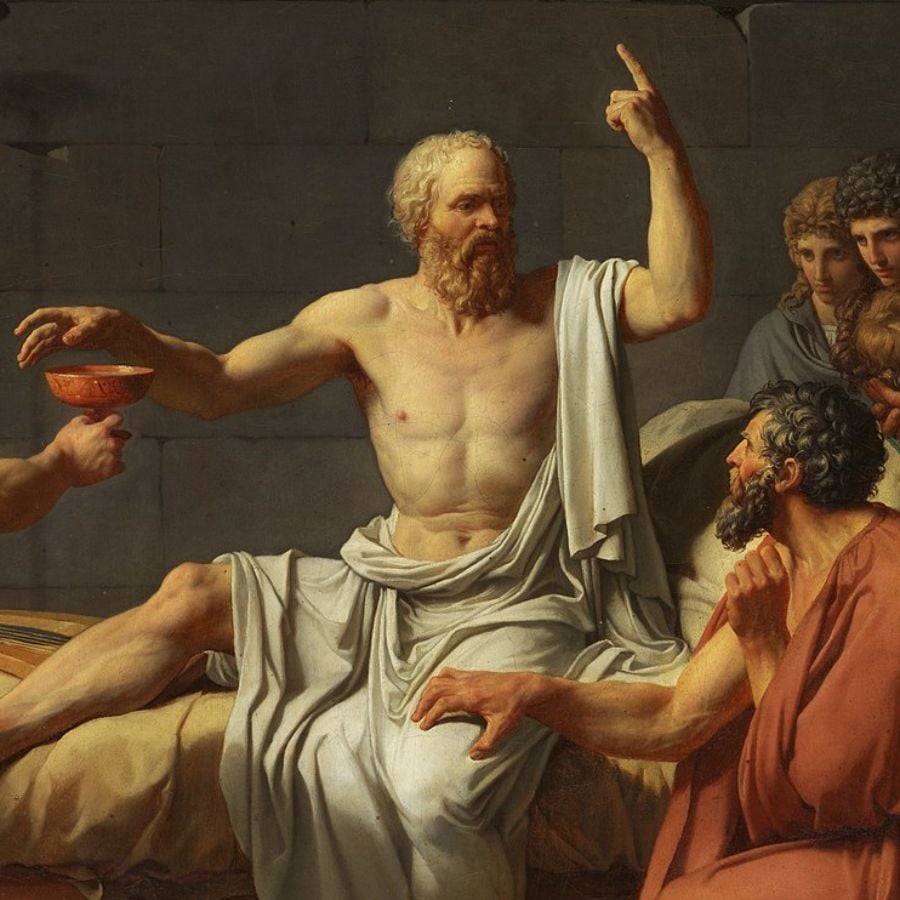

Preliminary notes: Sophist is a late Platonic dialogue. The work shows a change in Plato’s orientation towards practical knowledge. It is supposed to be part of three dialogues, including Statesman and Philosopher, the latter of which was never written by Plato. The work also seems to be linked with the works Theaetetus and Parmenides.
Although the work is supposed to be a dialogue in its form, but it remains so only in the initial parts, while later on when the Stranger from Elea starts searching or rather hunting the sophist, it almost becomes a monologue with the other interlocutors, mainly Thaetetus seem agreeable and acquiesce with the Stranger without presenting any objection.
It seems that Plato here through the idea of the other of the Philosopher i.e. The Sophist shows:
1) How false opinion is possible
2) Why “names” do not correspond to “kinds” or “ideas” of things
3) Presents the critique of the teaching of the “friends of forms”
We will also discover the inherent ethics attached to the Socratic search to distinguish between “the better and the worse” compared to the distinction between “like and like” of the Sophistic method.
The dialogue is a good demonstration of the Socratic method of division and collection to come up with a definition of something, which is the typical mode of Socratic questioning of the form “What is x?”. In terms, of content, the dialogue is an elaboration on the metaphysics of Kinds as well as the question of being and not-being.
Let’s start:
We are all gathered here to discuss the work of one of the great teachers of Philosophy, as students of Philosophy, we are being taught by one of the greatest ancestors of ours. I want to start with the question “What does it mean to do Philosophy?” Plato when writing this dialogue has started to somewhat disagree with what Socrates and his philosophy represents, especially his theory of forms. The dialogue is supposed to be part of a triptych consisting of the definition of the Sophist, the statesman, and the Philosopher. Are all of them one or are they three distinct characters with different qualities?
Though Plato didn’t write The Philosopher but reading the two works Statesman and Sophist we might get to see what a philosopher does, what are his concerns, and how he carries out his work, so we need to pay attention to both the method i.e. the form as well as the content of this dialogue.
Now, let’s start with the text then:
So, with the stranger and Theaetetus, we are trying to hunt the Sophist, a hunter himself, trying to hunt a hunter is a difficult task. Initially, the Sophist will appear six times, but later on, we will discover that we will not be able to catch him through these appearances only, there are more complex questions that we will need to deal with before hunting the Sophist.
Let’s start with the six clues that we have which will allow us to get a glimpse of the Sophist as well as give us a grasp of the problem we are dealing with when going on this hunt.
The stranger and we require a method to carry out this hunt, as dealing with the Sophist is more complex, the stranger suggests dealing with a simpler definition first, this will give us a model that we can deploy to carry out the more complex task of hunting down the Sophist.
From the very start, the stranger shows that one should not presume anything in Philosophy. The fundamental ground rule which he establishes makes this clear- “In every case, we need to be in agreement about the thing itself by means of a verbal explanation, rather than doing without any such explanation and merely agreeing about the name.” (218 d)
The stranger starts by coming up with the definition of an angler (a person who catches fish with a hook and fishing line). The stranger asks whether an angler is an expert or not, to which the obvious answer is, that he is indeed an expert. Now, expertise is divided into two kinds:
1. Production: Expertise in producing something by making it come into being
2. Acquisition: Expertise in taking or withholding the possession of something which has already been produced.
Where can we place the angler? Well, clearly under the second kind of expertise, which is acquisition expertise. The stranger further bifurcates this acquisition expertise into –
2. A. Mutual or willing exchange (mutual acquisition-gifts, wages, purchase, barter)
2.B. Taking or acquiring through one’s expertise (active acquisition-taking possession)
The angler again falls in the second part of this division that is the taking possession kind. Let’s bifurcate this taking possession further into two types:
2. B. i. Openly done (Combat)
2.B. ii. Secretly done (Hunting)
Now, angler again falls into the second kind, which is hunting, and as usual we will divide it into two:
2.B. ii. a) Hunting of living things
2.B. ii. b) Hunting of lifeless things
Now, angler falls in the hunting of the living things which we will bifurcate into two kinds again:
2.B.ii.a) I. Land Hunting
2.B.ii.a) II. Aquatic Hunting or Hunting those that swim
The angler will fall into the second kind, which as we know the procedure can be divided into two:
2.B.ii.a) II. 1. Hunting those with wings (Bird-catching)
2.B.ii.a) II. 2. Hunting those living underwater (Fishing)
As we have gotten the idea now, let me a bit efficient here:
.png)
And with this, we have found what angling is. And thus The stranger clarifies, “not just its name; in addition, we’ve also sufficiently grasped a verbal explanation concerning the thing as a whole”.
Let’s see how the method of division and collection worked here:
.png)
By
Arnav Madhav JNU




 KALA
KALA 
Leave a comment